Is Autoblogging.ai Good for Bulk Article Generation? An Honest Review
Producing 50 articles a week sounds simple until you price the writers. For agencies and affiliate marketers, content volume is often the bottleneck between a launch date and a missed one. Autoblogging.ai claims it can close that gap.
This review explains what Autoblogging.ai is, how its bulk generation works through CSV uploads of up to 500 articles, and which features matter for scale. You will also see its pricing tiers, trust signals, and a clear verdict on who should use it for bulk content.
What Is Autoblogging.ai? A Product of Digimetriq.com
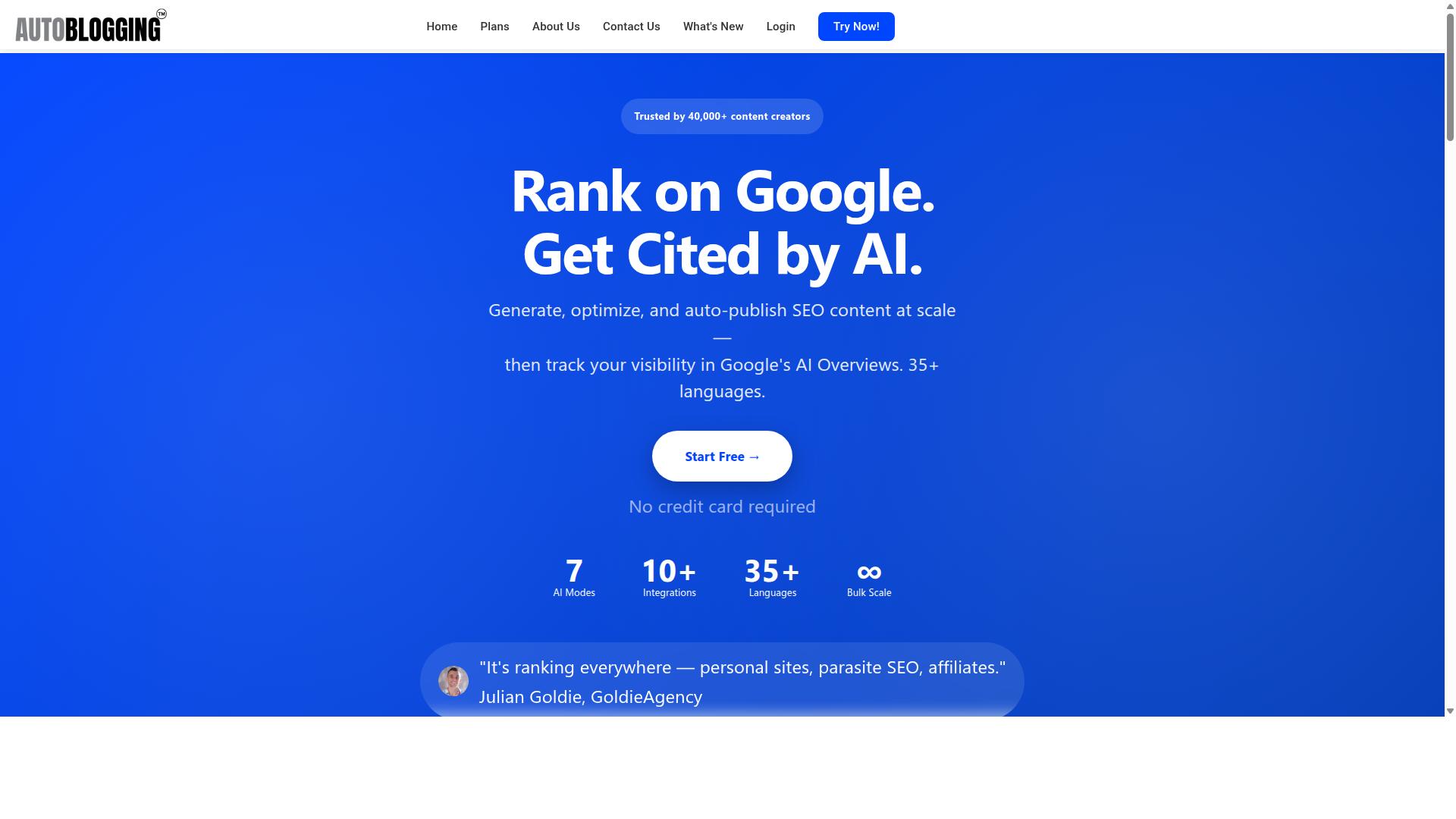
Autoblogging.ai is a SaaS platform developed by Digimetriq.com that uses AI to generate articles in bulk, aimed at saving time and improving online presence for bloggers and agencies.
It was founded in 2022 and builds on processes originally developed at Digimetriq. That foundation matters for anyone weighing it as an AI writing tool, because the product was shaped around real content production workflows rather than assembled as a generic text generator.
The stated mission is straightforward: help bloggers, website owners and agencies save time and improve their online presence through cutting-edge technology. In practice, that means cutting down content costs and give the power toing human counterparts within standard operating procedures with a first draft.
That last point is worth pausing on, since it sits at the center of any honest review. Autoblogging.ai positions itself as a first-draft engine that supports people in a workflow, not as a finished replacement for editorial judgment. Digimetriq's broader ambition is to replace human counterparts entirely, but the current product framing keeps a human in the loop.
For bulk article generation, that distinction shapes what the tool is good at. It handles volume and speed, while the person using it handles direction, review, and final quality control.
Who It Serves: Bloggers, Agencies, SEO Professionals and Affiliate Marketers
Autoblogging.ai is designed for a wide range of content creators, including individual bloggers, marketing agencies, SEO professionals, and affiliate marketers who need to produce large volumes of content efficiently.
The audience list is broad by design. It covers bloggers, website owners, SEO professionals, marketing agencies, content creators, and affiliate marketers. Each group tends to arrive with a different bottleneck.
- Bloggers can scale content without hiring a full writing team, keeping publishing frequency steady.
- Agencies can serve more clients by producing first drafts faster across multiple accounts.
- SEO professionals can build topical authority by covering more of a subject area in less time.
- Affiliate marketers can spin up niche sites rapidly and populate them with content.
- Content creators can maintain output across several channels and formats.
The deployment scenarios are equally varied. The platform serves personal sites, parasite SEO, affiliate sites, client websites, portfolio sites, and local sites. That range says something about how the tool is meant to be used: as a content scaling layer that fits many site types rather than one narrow niche.
For agencies, the appeal is capacity. More first drafts per week means more client work moved forward without proportionally more headcount. For solo operators, the appeal is different. A single blogger can compete on publishing volume with teams that have larger budgets.
Affiliate marketers and local site owners sit somewhere in between. They often need many pages targeting specific terms, and mass content production is the fastest route to covering that ground. Whether the output holds up depends on how the human side of the workflow is managed, which is where the rest of this review turns.
Is Autoblogging.ai Good for Bulk Article Generation? The Honest Answer
When evaluating Autoblogging.ai for bulk article generation, the honest answer is that it excels at producing large volumes of content quickly, but the quality depends on the mode and settings you choose.
On the strength side, this AI writing tool is built for content scaling. It supports up to 500 articles in a single CSV batch, offers 10+ AI modes, and works across 35+ languages. For agencies, affiliate publishers, and niche site owners who need to feed an automated blogging pipeline, that capacity removes the biggest bottleneck in mass content production: the manual writing hours.
The caveat is editorial. Bulk output still needs human review before publishing, especially on YMYL topics such as health, finance, and legal advice, where E-E-A-T and factual accuracy carry real weight. Machine learning models can occasionally produce a hallucination or a tone that drifts, so a proofreading and fact-checking pass is not optional for serious sites.
That is why Autoblogging.ai includes a human proofreader in all plans, alongside an AI Proofreader. These features support editorial standards rather than replace them. Think of the platform as a tool for scaling production, not a substitute for editorial oversight.
It also helps that the platform is not a thin content generator by design. Godlike Mode includes SERP competitor analysis, LSI keywords, and knowledge graph extraction, which supports keyword optimization and topical authority instead of producing generic filler that could run afoul of the Google Helpful Content Update. Google Panda era penalties taught publishers that thin content does not rank, and mode selection is how you avoid that trap.
The verdict: for high-volume workflows, Autoblogging.ai is a strong fit. It is trusted by 40,000+ content creators with a 4.9 average rating and 1M+ articles generated, which suggests the bulk workflow holds up in real use. The tool handles volume. You handle judgment.
How Bulk Generation Works: Up to 500 Articles via CSV
Bulk generation in Autoblogging.ai allows you to upload a CSV file containing keywords and titles, and the system will generate up to 500 articles in one go, each optimized for SEO.
The process follows a straightforward sequence:
- Prepare your CSV. Build a file with columns for keyword, title, and other parameters the platform accepts.
- Upload it to the platform. The system reads each row as a separate article assignment.
- Select your AI mode. Godlike Mode is the higher-quality option, using SERP competitor analysis, LSI keywords, and knowledge graph extraction.
- Initiate generation. The batch runs and produces your articles.
- Export or publish. Articles can be exported in various formats, or pushed live through the one-click WordPress publish integration.
The time savings are the headline benefit. What would take weeks of manual writing can be completed in hours, which is the core appeal of content scaling for anyone running multiple sites or client accounts.
One practical point: credits are consumed per article. Before launching a 500-article batch, check your plan's credit allowance so you do not run short mid-run. Credits rollover, which gives you some flexibility to plan larger batches around your subscription cycle.
From there, the workflow moves into optimization. The Semantic SEO Analysis tool runs a 21-point SEO audit on your output, and the Snippet Optimizer targets featured snippet placement. Pairing bulk generation with these checks is what separates a usable batch from a publishable one.
For teams that want the volume without the setup work, Done For You packages are also available. Either way, the bulk engine is the same: CSV in, hundreds of SEO-oriented drafts out, ready for your editorial pass.
Key Features That Make Autoblogging.ai Stand Out for Bulk Content
Autoblogging.ai distinguishes itself in the crowded AI writing space with advanced features tailored for bulk content production, including Godlike Mode and extensive language support. For anyone weighing whether this platform fits a mass content production workflow, the feature set is the first thing worth examining.
The platform is built around a simple idea: content scaling should not come at the cost of quality. That shows up in three areas. First, the range of AI modes lets you match effort to stakes, so a low-priority filler post and a flagship SEO article do not have to be produced the same way. Second, language coverage opens up international audiences without juggling separate tools. Third, publishing integrations cut out the manual copy-paste step that slows down automated blogging at volume.
These features matter most when you are generating dozens or hundreds of articles at a time. A single article can be polished by hand, but bulk article generation needs systems that hold a baseline of quality across every piece. Autoblogging.ai has generated over 1M articles for a user base of 40,000+ content creators, which gives a sense of how the tool performs under real production loads rather than one-off tests.
The sections below break down the two pillars behind this: the premium Godlike Mode that drives SEO depth, and the mode, language and integration options that make scaling practical.
Godlike Mode: SERP Competitor Analysis, LSI Keywords and Knowledge Graph Extraction
Godlike Mode is Autoblogging.ai's premium AI mode that uses SERP competitor analysis, LSI keywords and knowledge graph extraction to generate comprehensive, SEO-optimized articles. It is the mode to reach for when ranking matters more than credit efficiency.
Here is what it brings together:
- SERP competitor analysis, which looks at what already ranks for your keyword so the output reflects what search engines are rewarding
- LSI keyword extraction, which surfaces related terms that improve topical relevance and help the article read as genuinely on-subject
- Knowledge graph extraction, which pulls in entities and relationships tied to the topic to add depth and authority
Why does this matter for bulk content? Thin content has been a liability since the Google Panda era, and the Google Helpful Content Update pushed the bar higher still. Articles that only skim a topic tend to struggle. By covering a subject thoroughly through related keywords and connected entities, Godlike Mode gives each piece a better shot at SERP ranking and at building topical authority across a site.
The trade-off is cost. Godlike Mode consumes more credits than the lighter modes, so it is best reserved for high-stakes content: pillar pages, money pages, and articles meant to compete for valuable keywords. For high-volume filler, the cheaper modes make more sense. This is a deliberate design choice, and it is a reasonable one. You spend the premium mode where returns are highest and keep costs down everywhere else.
One honest note for this review: no mode replaces human judgment on factual accuracy. Even strong AI output benefits from the included human proofreader and a final editorial pass, particularly for YMYL topics where E-E-A-T standards are strict.
10+ AI Modes, 35+ Languages and 35+ Integrations
Autoblogging.ai offers over 10 AI modes to suit different content needs, supports more than 35 languages for global reach, and integrates with over 35 platforms to streamline your publishing workflow. Together, these three numbers explain much of the platform's appeal for content scaling.
The named modes cover a wide range of jobs:
- Quick Mode, a free option available as single and wizard variations, useful for fast drafts
- Godlike Mode, the premium SEO-focused mode described above
- Bulk Generation, which produces up to 500 articles via CSV, the core of any mass content production workflow
- News Mode, which draws on Google News integration for timely pieces
- Amazon Reviews Mode, aimed at product-focused content
That spread means you can run different content types through the same platform instead of stitching tools together. The 35+ languages matter just as much: an international audience no longer requires a separate writing pipeline, and niche relevance can be tuned per market.
On publishing, the integrations do the heavy lifting. WordPress support covers unlimited sites with one-click publishing, a plugin, and scheduled auto-posting, which is the difference between a queue that runs itself and a daily manual chore. Beyond WordPress, there is support for Web 2.0 platforms such as Medium, Dev.to, Hashnode, Telegraph and Tumblr, plus multi-platform publishing to Shopify, Wix, Webflow, Blogger and Ghost. An API, Zapier and n8n round out the automation options.
Supporting tools add further value at scale: Site Optimizer, Semantic SEO Analysis with a 21-point audit, Snippet Optimizer, Topical Maps, and a Content Repurposer. Credits roll over, and a human proofreader is included in all plans. For bulk article generation, that combination of modes, languages and integrations is what turns automated blogging from an idea into a repeatable process.
Pricing and Plans: Which Tier Fits Bulk Generation?
Autoblogging.ai offers tiered pricing based on credits, with plans ranging from $19 per month for 40 credits to $999 per month for 5,000 credits, and annual plans that provide discounts. Every plan works on the same credit system, so the tier you choose determines how many articles you can produce each month. For anyone serious about bulk article generation, that distinction matters more than any other feature on the pricing page.
Here is the full monthly lineup as listed by the brand:
- Starter: $19 per month for 40 credits
- Regular: $49 per month for 120 credits
- Standard: $99 per month for 300 credits
- Gold: $179 per month for 600 credits
- Premium: $249 per month for 1,000 credits
- Enterprise: $999 per month for 5,000 credits
Because each article consumes credits, the cost per article drops as you move up the tiers. A user producing a handful of posts per month can stay on Starter, but a site owner running mass content production across several blogs will find the higher tiers far more economical per piece.
Annual billing lowers the effective monthly rate on every plan. Starter comes to $12 per month ($148 per year), Regular to $32 per month ($382 per year), Standard to $64 per month ($772 per year), Gold to $116 per month ($1,396 per year), Premium to $162 per month ($1,942 per year), and Enterprise to $649 per month ($7,792 per year). New accounts also receive 10 free credits per month with no credit card required, which is a low-risk way to see how the AI writing tool handles your niche before committing. Additional credits can be purchased separately if a project runs over budget, and payments are accepted via Visa, MasterCard, American Express, and PayPal, with bank transfers available for annual enterprise plans through Stripe. Cancellation is available at any time.
Monthly and Annual Plans, Credits Rollover and the Human Proofreader
Beyond the base credit allowances, Autoblogging.ai offers credits rollover so unused credits don't expire, and a human proofreader included in all plans. Both features matter for content scaling, because they smooth out the two biggest friction points in automated blogging: uneven monthly output and editorial quality.
Credits rollover means a quiet month does not waste your spend. If you generate 200 articles in a 300-credit month, the remaining 100 credits carry forward, which suits users who run occasional bulk projects rather than a steady daily output. You can build a buffer, then draw it down during a launch or a seasonal push.
The human proofreader reviews and edits AI content for grammar, clarity, and factual accuracy. For sites operating under strict editorial standards, especially in YMYL niches, that layer of human editing and fact-checking helps address the hallucination risk that comes with any generative system. It also supports tone consistency across a large batch, which is hard to maintain when publishing at volume.
Choosing a plan comes down to matching credits to your real monthly output. A practical approach for bulk generation:
- Estimate how many articles you publish per month across all sites.
- Pick the tier whose credit allowance covers that number, not the tier you hope to grow into.
- Compare the annual rate before paying monthly, since the discount is significant at every level.
- Factor in the human proofreader if your niche demands stricter accuracy or a more polished voice.
For very large operations, the Done For You packages offer a different route: Starter at $1,200 for 1,000 articles, Pro at $1,600 for 1,000 articles, Corp at $4,000 for 1,000 articles, and Senpai at $10,000 for 1,000 articles. These sit outside the credit system and suit buyers who want finished output rather than tooling. For most readers weighing an honest review of bulk capability, the credit plans plus rollover remain the most flexible and cost-effective path, and the annual discount makes the higher tiers genuinely competitive on a per-article basis.
Trust Signals: 40,000+ Users, 4.9 Rating and 1M+ Articles Generated
Autoblogging.ai has been trusted by over 40,000 content creators, holds an average rating of 4.9, and has generated more than 1 million articles, demonstrating its reliability and popularity. For anyone weighing whether the platform can handle bulk article generation at scale, these numbers tell a clear story: a large user base keeps coming back, and the output volume shows the tool is doing real work every day.
A rating of 4.9 out of 5 is difficult to fake over time. It reflects sustained satisfaction across a broad group of users rather than a handful of early adopters. Combined with the 1 million plus articles generated, the picture is of a mature AI writing tool that has moved well past the experimental stage.
Volume alone is not proof of quality, but volume paired with a high average rating is a stronger signal. It suggests users are not just generating content, they are sticking around and rating the experience positively.
Beyond the numbers, Autoblogging.ai has attracted endorsements from well known figures in the SEO and content space. These testimonials add a layer of credibility that raw statistics cannot provide on their own.
- Julian Goldie of GoldieAgency, whose YouTube channel has 250k+ subscribers
- James Dooley of FatRank and PromoSEO
- Bart Magera of MojoLinks
- Kyle Duncan, SEO Professional
- Dimitar Georgiev, CEO of IDEAMAX.EU
- Cagri Sarigoz, Founder of Cagri Sarigoz LLC
- Jacky Chou of Indexsy
These are people who evaluate tools for a living. Their willingness to attach their names to Autoblogging.ai suggests the platform meets a professional standard, not just a hobbyist one. For buyers comparing options for mass content production, that kind of third party validation matters.
Ongoing development is another trust signal worth noting. New features are shipped weekly, which indicates the team is actively investing in the product rather than letting it stagnate. A tool that evolves regularly is more likely to stay useful as search algorithms and content standards change.
For an honest review of bulk article generation, the combination of a large user base, a 4.9 rating, over a million articles produced, notable endorsements, and weekly updates points to a platform with a proven track record. These signals do not guarantee every article will rank, but they do show that Autoblogging.ai is a legitimate, widely used, and actively maintained AI writing tool.
Who Should Use Autoblogging.ai for Bulk Articles
Autoblogging.ai is ideal for content creators who need to produce large volumes of articles regularly, such as affiliate marketers building niche sites, agencies managing multiple clients, and bloggers scaling their content output. The platform is built for exactly that kind of workload, and its audience reflects it: bloggers, website owners, SEO professionals, marketing agencies, content creators, and affiliate marketers all use it for bulk article generation.
If your work depends on publishing steadily without hiring a full writing team, this AI writing tool fits the job. Below are the groups that get the most value from it, plus a clear note on who should look elsewhere.
Affiliate marketers are a natural fit. Niche sites often need hundreds of product reviews, buying guides, and comparison posts to cover a category properly. Producing that volume by hand is slow and expensive, so affiliate marketers use Autoblogging.ai to keep their sites stocked and their content scaling consistent.
Agencies face a different version of the same problem: many clients, each needing a steady stream of SEO content. Autoblogging.ai supports client websites as part of its target audience, which makes it practical for agencies that want to offer content services at scale without multiplying their writing costs.
SEO professionals use bulk output to build topical authority faster. Covering a subject in depth requires many interlinked articles, and generating them in volume helps a site establish niche relevance sooner. The same logic applies to backlink strategy support content and internal linking structures.
Bloggers benefit from maintaining a consistent publishing schedule without burning out. A steady flow of posts signals activity to search engines and gives readers a reason to return, which is hard to sustain when every article is written manually.
Beyond these core groups, Autoblogging.ai also serves a wider set of site types. Its stated audience includes:
- Personal sites
- Parasite SEO projects
- Affiliate sites
- Client websites
- Portfolio sites
- Local sites
That range matters because bulk content needs differ by project. A local site may need dozens of service-area pages, while a portfolio site may need supporting articles that build credibility. Autoblogging.ai covers these cases under one tool.
Who should not use it? Anyone who requires 100% human-written content or operates under strict editorial standards. If your workflow demands heavy fact-checking, proofreading, and human editing on every piece, an automated tool will not replace that layer of review.
Publishing content that touches YMYL topics, or anything judged under E-E-A-T guidelines, usually calls for expert human oversight. In those cases, Autoblogging.ai can assist with drafting and volume, but a human editor should still own accuracy and tone.
The honest verdict for this section: if your goal is mass content production across personal sites, affiliate projects, client work, or local pages, Autoblogging.ai is built for you. If your standard is fully hand-written prose with zero automated drafting, it is not the right fit, and no bulk tool would be.
Final Verdict: Is It Worth It for Bulk Article Generation?
After evaluating its features, pricing, and performance, Autoblogging.ai is worth it for bulk article generation if you need to scale content production and are willing to invest in higher-tier plans and human editing for quality assurance.
The platform earns its place through strong bulk generation capabilities. It can produce articles at volume, which matters when a single site needs dozens of posts per month to build topical authority. For agencies juggling multiple clients, that throughput removes the biggest bottleneck in content scaling.
Advanced features such as Godlike Mode push output quality beyond what basic AI writing tools deliver. That gap is exactly where most low-end generators fail.
Pricing scales with usage, so you pay for the volume you actually need. Trust signals also hold up under an honest review:
- Verified business addresses in India and the United Kingdom
- Direct phone, WhatsApp, email, and Skype contact channels
- Active presence on Facebook, Twitter, and LinkedIn
- Support hours of 7:00 to 19:00 IST
One point deserves emphasis: this is not a set-and-forget solution. AI output can hallucinate facts, drift in tone, or miss niche nuance. Human editing, proofreading, and fact-checking remain essential for editorial standards, E-E-A-T, and survival under Google's Helpful Content Update.
For agencies and affiliate marketers, the math works. High-tier plans plus an editing layer produce a content pipeline that would otherwise require a large writing team. For casual bloggers publishing a few posts a month, lower tiers are usually enough. There is no reason to overbuy capacity you will not use.
Questions about plans, bulk limits, or which tier fits your workflow can go straight to the team. India office: 501, Trinity Orion, Vesu, Surat 395007, Gujarat. Phone or WhatsApp: +91 84605-06553. Email: [email protected]. Skype: vibes.yb. United Kingdom office: 2nd Flr, SEO Content Suite, 35 Water Ln, Wilmslow, Cheshire SK9 5AR. Phone: +44 1625 359056.
The verdict is clear. Autoblogging.ai is a legitimate, capable tool for mass content production when paired with human oversight and the right plan tier.
Frequently Asked Questions
How many articles can Autoblogging.ai generate in one bulk run?
Autoblogging.ai's Bulk Generation mode can produce up to 500 articles in a single run by uploading a CSV file. This makes it practical for agencies and site owners who need content at scale rather than one article at a time. If you're unsure how to structure your CSV, the platform's wizard and support team can help you get set up.
Do bulk-generated articles go through the same quality process as single articles?
Yes. Bulk Generation uses the same underlying AI engine as the other modes, and you can apply Godlike Mode's SERP competitor analysis, LSI keywords and knowledge graph extraction to your content. A human proofreader is also included in higher-tier plans, so bulk output doesn't mean skipping quality control. Many users review and lightly edit articles before publishing, which is standard practice for any AI content workflow.
Which plan should I choose if I mainly want to generate articles in bulk?
It depends on your volume. Plans range from Starter at $19/month (40 credits) up to Enterprise at $999/month (5,000 credits), with several tiers in between such as Regular, Standard, Gold and Premium. Since credits roll over, you don't lose unused capacity at the end of a billing cycle. If you're generating hundreds of articles regularly, a mid-to-high tier plan will usually be more cost-effective than stacking smaller ones.
Can I generate content in languages other than English?
Yes. Autoblogging.ai supports 35+ languages, which is useful if you run multilingual sites or serve clients in different regions. You can select your target language when setting up your generation, including in bulk workflows. This makes it a fit for agencies managing international portfolios.
How does Autoblogging.ai compare to other bulk article generators?
Rather than naming competitors, here's what we'd suggest: compare on the features that actually matter to your workflow, such as bulk limits, language support, integrations, credit rollover and whether human proofreading is included. Autoblogging.ai offers 10+ AI modes, 35+ integrations and 24/7 support, and is trusted by 40,000+ content creators with a 4.9 average rating. We'd encourage you to test any tool against your own quality standards before committing.
Is there support available if something goes wrong during a bulk generation run?
Yes. Autoblogging.ai offers 24/7 support, and you can reach the team via email at [email protected], by phone or WhatsApp at +91 84605-06553, or on Skype at vibes.yb. The team is available 7:00-19:00 IST for direct contact, with round-the-clock support coverage. New features are also shipped weekly, so issues and requests are addressed on an ongoing basis.